

 NinjaCalc
AI Accelerators

AI accelerators (also called neural processing units, NPUs, or AI co-processors) are integrated circuits designed to run machine-learning inference workloads (e.g. neural networks) far more efficiently than a general-purpose CPU. They are commonly paired with a host processor, offloading the heavy matrix/tensor maths involved in running a model. Performance is often quoted in TOPS (tera-operations per second).
Neural networks work by having many layers of “neurons”. The value of each neuron in each layer is calculated by:
- Taking a linear weighted sum of all the neurons in the layer before it: , where is a bias term (assuming a dense network in where a neuron connects to every neuron in the previous layer)
- Applying a non-linear activation function: where might be something like (output the value if the value is positive, otherwise 0, a.k.a. ReLU).
The most computationally intensive part of running a neural network are the weighted-sum calculations. These can be easily done with matrix multiplications. An AI accelerator has dedicated hardware that is optimised for these matrix operations.
Hailo-8L
The Hailo-8L is an entry-level AI accelerator from Hailo, delivering up to 13 TOPS. It is widely used in edge-AI and computer-vision applications (for example, on the Raspberry Pi AI Kit). It is designed to run neural networks.
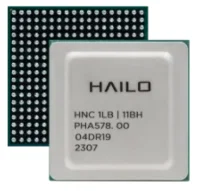
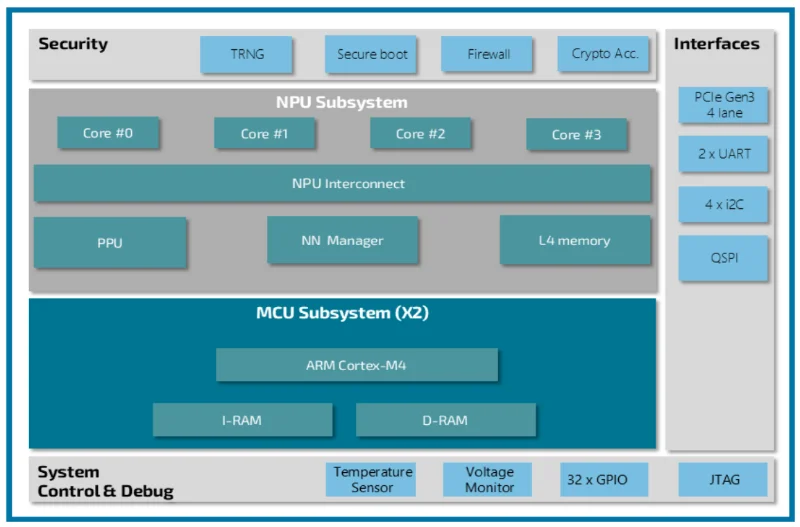
The Hailo-8L contains the following components2:
- NPU: Up to 13 TOPS.
- MCU: Dual ARM Cortex-M4 processors running at 200 MHz. 640 kB SRAM. FPU and MPU.
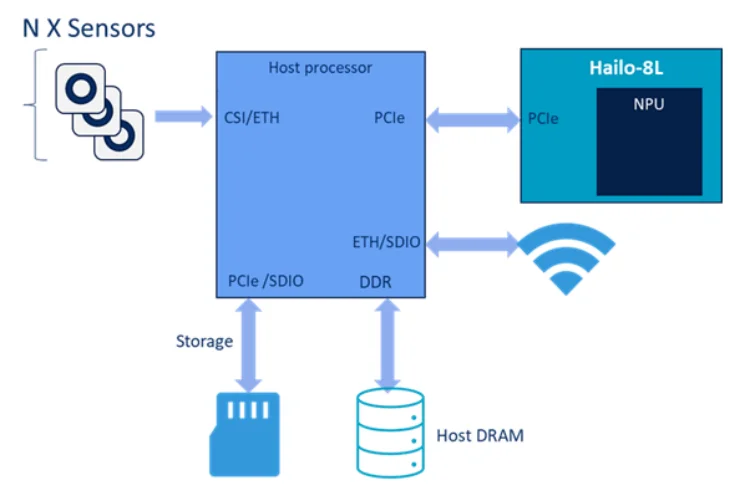
- 4-lane PCI express Gen3 endpoint with integrated PHY (this is designed to be connected to the host processor)
- 2 UART interfaces.
- 4 I2C interfaces.
- Quad SPI interface (for external flash devices)
It is designed to be connected to a host processor via the PCIe link as shown below.
Footnotes
-
Hailo. Hailo-8L Entry-Level AI Accelerator [product page]. Retrieved 2026-06-08, from https://hailo.ai/products/ai-accelerators/hailo-8l-ai-accelerator-for-ai-light-applications/. ↩
-
Hailo (2026, Apr). Hailo-8L Datasheet [datasheet]. Retrieved 2026-06-08, from https://hailo.ai/hailo-files/hailo-8l-industrial-datasheet-en/. ↩ ↩2 ↩3