

 NinjaCalc
Cameras

Cameras are devices that capture images/video and convert them into an analogue or digital signal. At the heart of a camera is an image sensor, which in today’s cameras is usually a CMOS (complementary metal-oxide-semiconductor) sensor. The image sensor is made up of an array of pixels, which are light-sensitive elements that convert light into an electrical signal.
This image sensor is usually paired with a lens which focuses light onto the sensor. There are a number of different camera and lens types available for embedded systems.
Camera Sensor Parameters
Sensor Size (Optical Format)
The sensor size (a.k.a. optical format) is the physical size of the image sensor in a camera. It is usually measured as the diagonal of the sensor in either a weird fraction of an inch (e.g. 1/2.3”) or directly in millimetres (e.g. 6.3 mm).
The 1/2.3” format is a legacy convention from the 1950s vacuum-tube video cameras (vidicons). A “1-inch” tube had a glass tube diameter of 1 inch (25.4 mm) in diameter, but the usable image area was only about 2/3 of that, approx. 16 mm (on the diagonal). Solid-state sensors replaced tubes, but manufacturers kept the same naming convention, quoting the size of a hypothetical tube that would have the same image area.
As a general rule-of-thumb:
Sensor size is important because:
- Light gathering: A bigger sensor (at the same resolution) has bigger pixels, which can gather more light and produce better images in low-light conditions (and give better dynamic range).
- Lens compatibility: The len’s image circle must be at least as big as the sensor so that you do not get vignetting (dark corners).
- Field of view: For a given lens focal length, a bigger sensor will give a wider field of view.
To give some examples:
Front-side vs Back-side Illumination
CMOS image sensors can be either front-illuminated or back-illuminated. Front-illuminated sensors (FSI) are the traditional design in which light enters the sensor from the front. But in standard chip fabrication processes, the metal layers and transistors that connect to each pixel are built on top of the silicon substrate, which blocks some of the light from reaching the photodiodes.
Back-illuminated sensors (BSI) flip the sensor around so that light is now entering the back. The back of the wafer is ground/etched down so it is just a few microns thin. Light can pass through this relatively easily, and then hits the photodiodes directly without being blocked by the metal layers and transistors. This improves the quantum efficiency of the sensor.
Stacked Sensors
Closely related to back-illumination, stacked sensors is taking the BSI concept further by separating the pixel array die from the logic die. This allows the pixel array to be optimized for light gathering, while the logic die can be optimized for processing speed and power consumption (different process nodes). The two dies are then bonded together face to face. In BSI but non-stacked sensors, the readout circuitry has to be placed around the edges of the pixel array, which limits the fill factor (the percentage of the sensor area that is light-sensitive).
IP Cameras
IP cameras are cameras that are connected to a network and can be accessed via a IP address. Many of them support PoE, allowing a single cable to both power the camera and provide a network connection.
ONVIF (Open Network Video Interface Forum) is an popular standard that IP cameras can support.
Camera Sensors
Some popular camera sensor manufacturers:
- Sony: IMX family (e.g. IMX477, IMX296)
- OmniVision: OV family (e.g. OV5647, OV7251)
IMX296
The IMX296 is a 1.6 megapixel image sensor from Sony with a global shutter. The global shutter makes it suitable for capturing fast moving object without the motion blur that can occur with rolling shutters.2 Arducam sells a camera module containing the IMX296 with an M12 lens mount, designed for the Raspberry Pi.3
| Feature | Specification |
|---|---|
| Resolution | 1440 x 1080 |
| Pixel Size | 3.45 um x 3.45 um |
| Sensor Size | 1/2.9” (6.3 mm diagonal) |
| Interface | MIPI CSI-2 |
| Shutter Type | Global Shutter |
| Frame Rate | 1440x1080 @ 60 fps |
| Output Format | RAW10 |
IMX477
The IMX477 is a 12.3 megapixel CMOS image sensor from Sony. It is a backside illuminated stacked image sensor with a square pixel array. It has a electronic shutter with variable integration time. It is in the Raspberry Pi High Quality Camera and the Arducam IMX477 module.4
The pixel size is 1.55 um x 1.55 um which allows for good low-light performance. The sensor array is 4056 x 3040 pixels.
| Feature | Specification |
|---|---|
| Resolution | 4056 x 3040 (12 MP) |
| Pixel Size | 1.55 um x 1.55 um |
| Sensor Size | 1/2.3” (7.853 mm diagonal) |
| Interface | MIPI CSI-2, D-PHY spec. v1.2 compliant |
| Shutter Type | Rolling Shutter |
| Video Modes | 1080p @ 30 fps, 720p @ 60 fps, 640x480 @ 60/90 fps |
| Output Format | RAW12 |
The MIPI CSI-2 interface supports 2 or 4 data lanes, with a max. of 2.1 Gbps per lane. It is D-PHY spec. v1.2 compliant, and supports 8/10/12-bit RAW output formats.5
Camera Modules
MIPI CSI-2 is the most common standard for connecting cameras to processors in mobile and embedded devices — see the MIPI CSI Communication Protocol page for more info on how the protocol works.
Some popular camera module manufacturers (they take a “raw” camera sensor and package it into module):
- Arducam: Online orders were sent by Nanjing Paichi Elec. Co. Ltd. (I presume this is the same company/parent company)
- Raspberry Pi
- Weinan Electronics
Arducam IMX296 Camera Module
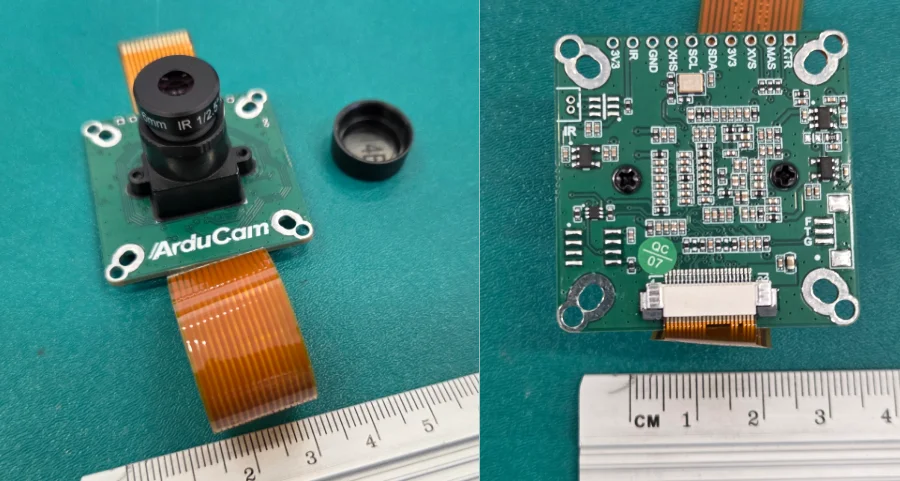
The Arducam IMX296 camera module is a small camera module that includes the global shutter Sony IMX296 image sensor, a M12 lens mount, and a 15-to-22 pin FPC connector for MIPI CSI-2. It also comes with a 45° (HVOF) M12 lens (this can be swapped out as needed).3
Lenses
A lens is an optical device that focuses light onto the image sensor. The lens determines the field of view, depth of field, and overall image quality.
What does a lens do? Consider a tip of a pencil. It scatters light in all directions. The whole cone of those rays enters the lens aperture. Light rays from the pencil tip hit the top, bottom and central parts of the lens. The lens then bends all rays from that one source point so they reconverge at a single point on the image plane.
For a thin lens, the equation is:
Where:
- is the distance from the object to the lens.
- is the distance from the lens to where the image forms.
A pinhole camera avoids the problem of sorting a cone of light rays from every object and instead only allows a single ray from each object to pass through the pinhole. This makes it sharp and in focus for any distance, at the expense of being very dim. A lens allows more light to enter the camera (it allows a cone of light from every object), but it requires focusing to ensure that the image is sharp.
Focal Length
The focal length is the distance from the lens to the image sensor when a subject at infinity is in focus. It is usually measured in millimetres (mm). A shorter focal length gives a wider field of view, while a longer focal length gives a narrower field of view.
Effective focal length (EFL) is the optical focal length of the whole lens assembly. This is the distance from the lens’s rear principal plane to the focal point. The principal plane is a theoretical plane that can sit anywhere (even inside or in front of the glass).
Back focal length (BFL) is the distance from the rear surface of the lens to the image plane. This tells you how much clearance exists between the back of the lens and the sensor. This space is where IR filters, cover glass and other optical elements are placed. For M12, which has no standard flange height, this also tells you how tall your lens holder needs to be.
For example, the the M12 Arducam LN001 telephoto lens, the EFL is 16 mm but the BFL is only 7.1 mm. The optics makes the principal plane sit out the front of the lens, and the whole assembly is shorter than the focal length.
Field of View
The field of view (FoV) is how much of the scene the camera captures. It depends on both the focal length of the lens and the size of the sensor. The diagram below shows the geometry.
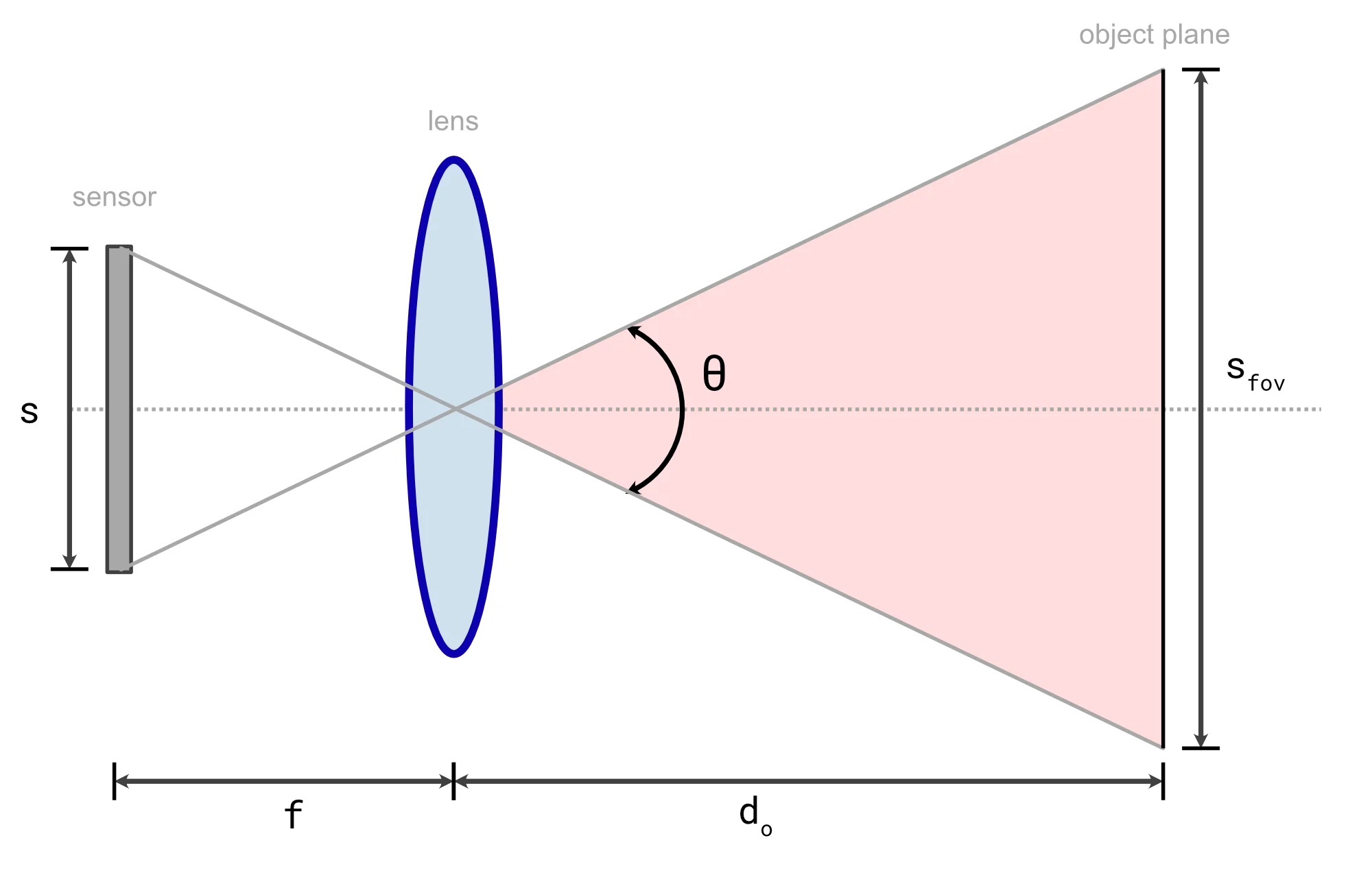
Under the thin-lens model, the angular field of view is:
and the size of the scene captured at a working distance from the lens is:
Where:
- is the angular field of view in radians.
- is the size of the scene captured at the working distance, in mm.
- is a dimension of the sensor’s active pixel array, in mm.
- is the focal length of the lens, in mm.
- is the working distance from the lens to the object, in mm.
The equations work for any of the three sensor dimensions — width, height or diagonal. For example, if you substitute in the sensor width you get the horizontal angular field of view (and the width of the captured scene); substitute the sensor height or diagonal and you get the vertical () or diagonal () field of view instead.
For working distances much larger than the focal length this simplifies to the familiar .
These equations only hold for low-distortion (rectilinear) lenses. Wide-angle and fisheye lenses have strong barrel distortion which “squeezes” a wider scene onto the sensor, so their real field of view is considerably wider than the focal length predicts.
Lens Field of View Calculator
A common design task is working out what focal length lens you need so that a camera sees an object of a certain size at a certain distance, and how much detail (mm per pixel) you get on that object. The calculator below solves this using the field of view equations above.
The lens preset dropdown is populated with the 10 lenses from the Arducam M12 lens set (SKU LK005), a popular lens kit for embedded cameras covering focal lengths from a 16 mm telephoto down to a 1.7 mm fisheye.6
Mounts
Lens mounts hold the lens in the correct place in-front of the image sensor. The image sensor is typically mounted on a circuit board with one side of the mount, and the lens has a mating piece which screws or slides on. There are a few common lens mounts used for embedded cameras.
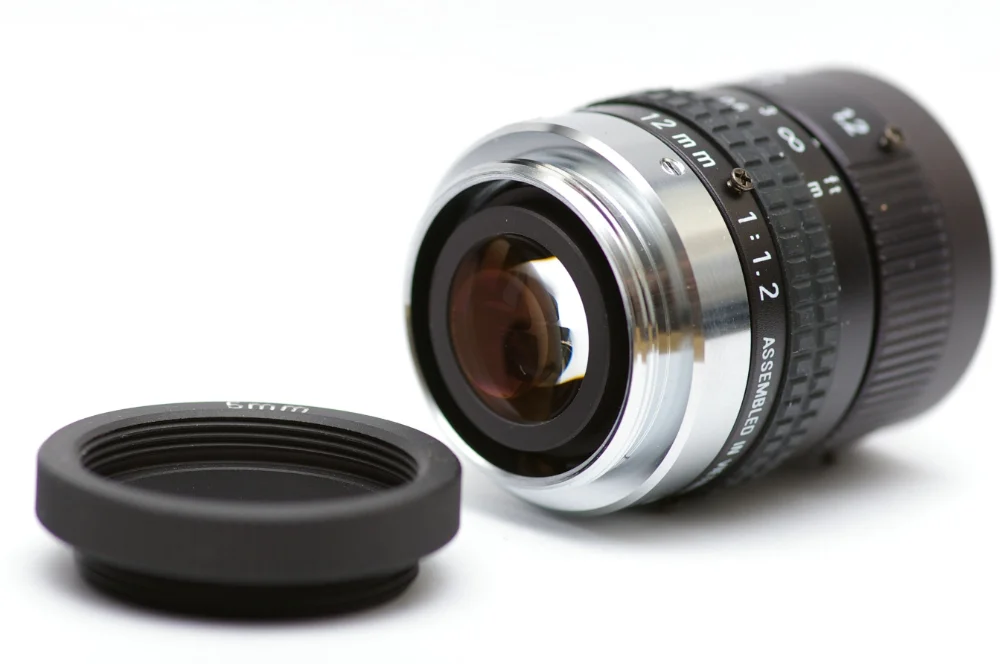
C-mount
A 1-inch diameter, 32 threads per inch lens mount. The flange height (distance from the top of the flange to the sensors image plane) is 17.526 mm.7
CS-mount
Has the same 1-inch diameter and 32 threads per inch thread as the C-mount, but with a shorter flange height of 12.526 mm. A C-mount lens might work on a CS mount camera, but it doesn’t normally work the other way around (a CS-mount lens on a C-mount camera won’t focus).8
M12-mount
A small lens mount that has a M12 x 0.5 thead (12 mm nominal diameter and 0.5 mm thread pitch). Unlike C and CS-mount, it does not have a standardized flange height. Because of this, M12 lens must be screwed in and out until they are in focus (and then sometimes secured with a screw or glue). It is smaller and lighter (≈10 grams) than the CS/C-mount and used when space and weight constraints are important. It is also known as an S-mount.9
Footnotes
-
GSMArena Team (2025, Feb 5). Samsung Galaxy S25 review: Camera. GSMArena. Retrieved 2026-07-21, from https://www.gsmarena.com/samsung_galaxy_s25-review-2794p5.php. ↩ ↩2
-
Arducam. 1.58MP IMX296 [documentation]. Arducam Wiki. Retrieved 2026-07-20, from https://docs.arducam.com/Raspberry-Pi-Camera/Native-camera/Global-Shutter/1.58MP-IMX296/. ↩
-
Arducam. 1.58MP IMX296 Color Global Shutter Camera Module with M12 Lens for Raspberry Pi [product page]. Retrieved 2026-07-28, from https://www.arducam.com/1-58mp-imx296-color-global-shutter-camera-module-with-m12-lens-for-raspberry-pi.html. ↩ ↩2
-
Arducam. 12MP IMX477 [documentation]. Arducam Wiki. Retrieved 2026-07-20, from https://docs.arducam.com/Raspberry-Pi-Camera/Native-camera/12MP-IMX477/. ↩
-
Sony Semiconductor Solutions (2018, Dec 12). IMX477-AACK - Diagonal 7.857 mm (Type 1/2.3) 12.3 Mega-Pixel CMOS Image Sensor with Square Pixel for Color Cameras [product flyer]. Retrieved 2026-07-22, from https://www.sony-semicon.com/files/62/pdf/p-13_IMX477-AACK_Flyer.pdf. ↩
-
Arducam. Arducam M12 Lens Set, Arducam Lens for USB Camera(1/2.7” 1/2.8” 1/2.9”), Telephoto, Macro, Wide Angle, Fisheye Lens Kit (20°- 180°) with M12 Lens Holder and Cleaning Cloth, Optical All-in-One [product page]. Retrieved 2026-07-23, from https://www.arducam.com/arducam-m12-lens-set-arducam-lens-for-usb-camera1-2-7-1-2-8-1-2-9-telephoto-macro-wide-angle-fisheye-lens-kit-20-180-with-m12-lens-holder-and-cleaning-cloth-optical.html. ↩
-
Wikipedia (2025, Jul 25). C mount [wiki]. Retrieved 2026-07-24, from https://en.wikipedia.org/wiki/C_mount. ↩ ↩2
-
Commonlands Optics. Types of Camera Lens Mounts - C-Mount, CS-Mount, and M12 Mount (S-Mount). Retrieved 2026-07-21, from https://commonlands.com/pages/lens-mounts-101. ↩
-
Commonlands Optics. What Is an M12 Lens? S-Mount Definition, M12 x 0.5 Thread, and Selection Guide. Retrieved 2026-07-21, from https://commonlands.com/blogs/technical/what-is-an-m12-lens. ↩